|
|
UC
Graduate Studies Catalog 2019-2023 Section IX Doctoral Degrees |

To merit the award of a doctorate,
the quality of a candidate’s work is judged on a variety of factors. The
initial lecture-based component with assignments is followed by an Intermediate
Comprehensive Exam. Having passed this, a candidate is required to produce a
Dissertation based on research which makes a significant original contribution
to knowledge in their chosen field.
1. The Doctoral Students’ Academic
Committee
MoEYS requires that each university establish a committee (their Science Board for Doctoral Programs)
to overview applications to study for a doctoral degree and to subsequently
monitor successful applicants’ progress.
Thus the Doctoral Students’ Academic Committee at The University of
Cambodia is responsible for the initial vetting of applications based on the
documentation supplied and any follow-up interviews (see Section IX.2).
Thereafter this committee is responsible for assigning successful
candidates to an advisor from the full- or part-time faculty to assist in
monitoring their progress. The advisor
of each student is responsible for routinely keeping the Committee informed of
any problems through the (Associate) Dean of the student’s College or School
and the Dean of Graduate Studies.
Section VI.1 provides detailed guidelines regarding the documentation required to be submitted by prospective students.
Ø Prospective Doctoral students must have a grade point average (GPA) of at least 3.00 or completed the thesis option at Master’s level.
In general, MoEYS does not require that students enroll for a doctoral degree in the same general area as their previous academic qualifications. An exception is in the case of a Doctorate in Law, where applicants are required to have at least a Bachelor’s of Law degree from a recognised university.
In addition, prospective Doctoral students should also include three sealed letters of recommendation from referees who can vouch for the candidate as an asset to the relevant degree program, through being able to contribute personal experiences and insights in a constructive manner.
Ø
Typically, these should
comprise two from previous supervisors and one from a manager or other relevant
reference.
Ø
In the case of applicants
with a Master’s degree not related to the proposed doctoral study program, they
may be required to take and pass up to three bridging courses in order to earn
a Pre-Doctoral Certificate in their chosen field and thus be considered for
admission.
Furthermore, such students should must include an original preliminary research proposal of at least 5,000 words, to demonstrate their understanding of their proposed field and the relevance of this specific area of study (together with an awareness of the relevant methodologies and their limitations), including a review of the relevant literature.
i. This is only for initial evaluation purposes by the Doctoral Students’ Academic Committee, and does not commit either the student, if successful, or The University of Cambodia to a particular field of study once the student has completed the prerequisite study modules.
ii. The applicant may be required to make a formal presentation on the proposed research topic.
iii. Students who did a thesis for their Master's degree should also submit a copy of this (together with an extended summary in English if the original was in another language).
The University of Cambodia’s Doctoral Students’ Academic Committee will interview applicants to review the applicant's academic background and related experience, and also inform the student of what is expected of them.
i.
Where an applicant is deemed to be acceptable, a copy
of the submitted materials together with a report on the interview will be sent
to MoEYS for their approval.
ii.
Once approved, the Doctoral student can commence
studies in Term I of the next Academic Year.
i. Transfer Students Doctoral students who were in good standing at another accredited university may transfer up to 27 credits (i.e. those who are 'all but dissertation': see Section IX.3.i) to study in an equivalent program at The University of Cambodia. To be considered for transfer, a course done at another university must be equivalent to at least 3 credit-hours (45 contact hours); the subject matter of the course should be equivalent to an existing course which counts towards the student's chosen major at The University of Cambodia; and the prospective student should have scored at least the equivalent of a University of Cambodia ‘B’ grade. Prospective students should submit the original transcripts or study records form their previous institutions together with the relevant form to the Office of Admissions, Information and Registration for consideration by the Doctoral Students’ Academic Committee or its nominees.
Ø
The transferred courses will be recorded in the student's transcript as
their UC-equivalents (ungraded and with the annotation that they are transfer
credits), and cannot be repeated at The University of Cambodia.
Ø
Where the transfer
is for all 27 course-based credits, the candidate is required to sit and pass the Doctoral Intermediate
Comprehensive Exam.
For successful students
transferring to the International Track, they must first pass the English
Placement Test or provide other evidence for competence in the English language
before they can be admitted into a doctoral degree program at The University of
Cambodia.
3.The Overall Structure of a
Doctoral Degree
Full-time doctoral students are required to complete their degree program within six years; and part-time students within eight years. To do so, they are required to satisfactorily complete the minimum of 60 credits.
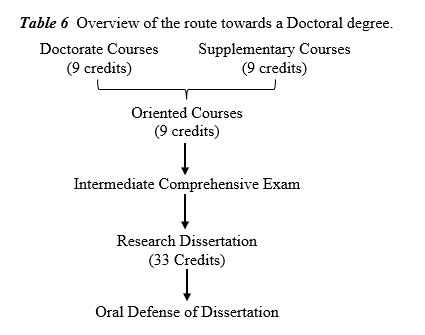
Table 6 provides an overview of the structure of Doctoral degree programs
at The University of Cambodia. There are two sequential components:
i.
a set of nine courses (27
credits); followed by
ii.
the preparation of a
dissertation.
The successful transition from the first to the latter depends on the
student’s adequate performance in an Intermediate Comprehensive Exam.
The following sections will consider each of these two components in
turn.
i. Course Requirements There are three categories of courses which
doctoral candidates are required to take and complete satisfactorily.
a. Doctorate level courses (9 credits):
Ø
FDN701: Research
Methodology (3 credits);
Ø
FDN702: Basic
Statistics (3 credits); and
Ø
FDN703: Research
Paper Writing (3 credits).
b. Supplementary
courses (9 credits):
Ø
FDN704: Ethical
Leadership (3 credits); and
Ø
two other courses related to the student’s general
field of study (6 credits).
c. Oriented courses (9
credits):
Ø
three related to
the student’s general field of study.
The
courses taken other than FDN701-4 are as advised by the Doctoral Students
Academic Committee after taking into consideration the student’s background and the inputs
of the relevant College or School.
Once a Doctoral student has
completed all coursework with a minimum overall Grade Point Average (GPA) of
3.0, they qualify for sitting the Intermediate Exam.
Ø
The GPA is based on the student’s performance in coursework: subsequent
common exams and performance in research are assessed as either ‘Pass’ or ‘Fail’.
Ø
Students should be
aware of the importance of attendance and class-participation (see Section V.1.ii).
Ø
A student is
allowed a maximum of three courses with a grade 'C'.
Ø
Further courses
with this grade, together with all courses at lower grades, count as grade 'F'
with a Grade Point of 0.
Ø
Failure to attain a
GPA of 3.0 after completing the 27 credits means that the student will be
dropped from the program.
The Intermediate Exam is a written exam, being two 3-hour sessions – morning and afternoon – on a single day.
Ø It comprises four compulsory questions in the candidate's chosen field or discipline, which are designed to test the student's integrative and analytical skills.
Ø The student’s answers to the questions in the Intermediate Exam will be reviewed in a subsequent oral exam by the Doctoral Students Academic Committee.
Ø Their overall performance will be recorded as a ‘Pass’ or ‘Fail’ on their transcript.
Ø There is no need for an additional Foreign Language Exam for students on the International Track.
A Doctoral student must satisfactorily complete all course-work and then pass a Intermediate Comprehensive Exam within three years of first joining a degree program for full-time students and four years for part-time students.
After passing the Intermediate Exam, a student is eligible, at the discretion of the Doctoral Students Academic Committee, to receive a Certificate of Recognition as a Doctoral Candidate, indicating that all requirements of the Doctorate except for the dissertation have been completed.
Ø
A student who fails
the Intermediate Exam may repeat it once at the discretion of the Doctoral Students Academic Committee.
Failing the exam a second time means dropping from the program with the loss of
registered graduate student status.
Successful students can then proceed to the next stage of their doctoral program.
ii. The Dissertation This constitutes a scholarly
presentation of an original contribution to knowledge resulting from
independent research. Typically, it is
based on a period of research after the successful completion of the
Intermediate Comprehensive Exam, followed by the writing of the dissertation
itself.
Ø
Note that, after first
registering for this, MoEYS’ regulations require that a student must register
for each subsequent term (including Term III) until final submission of an
acceptable piece of work.
Ø
This is to demonstrate the student’s
continuing commitment to completing their degree program, and to encourage them
to complete their work in as short a time as possible (for the student’s own
benefit).
Ø
Thus it is not recommended
that a student takes a Prolonged Leave of Absence (see Section VII.3) during
this time, since they will find it difficult to pick up where they left off
before.
However,
whilst still doing coursework, students
should plan ahead by identifying an area of interest, a possible topic for
research within that and a potential supervisor in consultation with their
respective College or School.
Having successfully completed the Intermediate
Comprehensive Exam, the student should submit a brief statement of their
interests to the Doctoral Students Academic Committee, with any supporting
documentation for the latter’s inputs. The
initiation, research and production of a dissertation are under the oversight
of a three-member supervisory panel,
nominated on the advice of the Doctoral Students Academic Committee. Based on
MoEYS’ guidelines, this panel comprises:
i.
a primary supervisor (who
cannot supervise more than nine students); and
ii.
two other members serve as
associate (or co-) supervisors, who may be either internal teaching faculty or
external local or international teaching faculty.
Thenceforth, following MoEYS’ guidelines, they are required to produce a dissertation (DIS805; 18 credits).The work involved in producing this should also be used to fulfill the following as byproducts:
i. national or international publication of research articles
(DIS802; 6 credits);
ii. presentations at fora and other meetings (DIS803; 3
credits); and
iii. personal seminars or workshops (DIS804; 3 credits).
Their performance each of
these will be recorded as a ‘Pass’ or ‘Fail’ on their transcript.
In order to achieve the
desired final product – a body of reported research which makes a significant
contribution to human knowledge and understanding – students are required to
respect the following basic principles:
Ø
making an activity plan with
agreement from supervisor panel, and abiding by it in order to meet various
deadlines;
Ø
keeping accurate records of
their data and the sources for review by others as necessary;
Ø
being conscientious and
honest in carrying out what they have proposed to do, with regard to the
collecting of the data and its analysis and presentation; and
Ø
not plagiarizing or
otherwise demeaning their personal integrity as scholars.
They must then make a presentation to the Thesis
Rehearsal Defense Committee.
i.
This comprises seven members, at
least two of who are from recognized external HEIs, with backgrounds in the
same field as the thesis topic.
ii.
The rehearsal will be conducted
in public.
iii.
Conditional approval,
recorded as a ‘Pass’ on their transcript, is required for the student to
proceed further.
iv.
If this is denied, the
student must present a revised version within three months for consideration.
v.
If this second presentation
is also not conditionally approved, then the student drops from the program.
Once the necessary changes to the thesis, based on
the feedback received, are approved by the supervisory panel, four copies must
be submitted to the Doctoral Students Academic Committee for onward
transmission to MoEYS with other documents as appropriate.
i.
This will include proposals for
the members of an Independent Thesis Review and Assessment Committee.
ii.
The members comprise an internal
assessor from the University of Cambodia, together with two other external
assessors.
The Final Thesis Assessment Committee, comprises
seven members: the chair, a minutes-taker, the three members of the Independent
Thesis Review and Assessment Committee, the primary supervisor, and one member
who is not a co-supervisor or associate supervisor and who is not a relative,
friend, or close colleague of the candidate. Membership of this committee shall
be decided by MoEYS based on the proposal of the Doctoral Students Academic
Committee.
Based
on a majority decision regarding the outcome of the defense, the candidate may
be considered to satisfy one of the following criteria:
– Pass;
– Provisional Pass with Minor Rewrite;
– Provisional Pass with Major Rewrite; or
– Fail.
Based
on the feedback from the above, the Doctoral Students Academic Committee shall submit a report on the final thesis defense and the thesis within
one month to MoEYS to review and decide the outcome.
Ø
In the case of a
major or minor rewrite, the candidate must submit a revised version of the
dissertation, with appropriate documentation of the changes made (or why
changes were not made) by an agreed deadline: where necessary, a second defense
may be called for.
Students who fail
their first thesis defense are allowed to a re-defense based on the following
criteria:
Ø
the candidate must make
adjustments to the thesis and apply for a re-defense within 24 months after the
date of the first defense; and
Ø
members of Re-Defense
Committee must be the same as those of Final Thesis Defense Committee; where
this is not possible, the University must propose substitutes to MoEYS.
Students who fail this re-defense are dropped from the
program and lose their status as registered graduate students.