The Best Students for Academic Year 2012-3 in the Context of Previous Years
By Dr. Angus Munro with assistance of Kong Rathana
Overview As in previous years, starting in Academic Year 2009-10, the proportion of enrolled Bachelor’s (non-Foundation Year) students receiving top grades was higher in Term III than in the other two terms. Overall, female students continued to have a proportionately higher representation amongst awardees than in the general student population. There was some evidence for differences between sessions, with evening classes tending to have fewer awardees. Over the four years, there was considerable between-College variability in the proportion of awardees. Some of the possible factors underlying this variation are considered.
Introduction In order to help further motivate students as a result of the decision to introduce a more stringent grading scheme with centralised exams (Munro, 2009), the University of Cambodia introduced a means to recognise our best-performing students each term and for the whole of each academic year.
Thus students who get an overall ‘A’ for a term are nominated to the Vice-President’s List for that term; maintaining that performance for the whole academic year means that they qualify for the Chancellor’s List. For students with at least ‘B+’ grades overall, the corresponding lists are the Dean’s and President’s. In each case, the students must have enrolled for the minimum number of courses (five in Terms I and II, and three in Term III: 13 overall).
The Best Students for Academic Year 2012-3 A list of the nominees to these various lists for Academic Year 2012-3 is appended to this article. It goes without saying that the recipients should be congratulated for their academic success; and that we hope that, rather than become complacent and rest on their laurels, this will encourage them to maintain this same high standard in the future. We also hope that it will inspire others to strive harder for something extra on their degree transcripts, to help them stand out from the competition.
An aggregate score (where being on the Dean’s or the Vice-President’s List in one term counts as 1 or 2, respectively) indicates that there are nine top students (with by-term aggregates of 4: all appeared on the Vice-President’s List for one term), as listed in Table 1. It is interesting to note the preponderance of female students (see also Munro, 2013a) and the absence of weekend students: these points will be explored further below.

It is important to remember that many good students studied for fewer than three terms in order to meet their graduation requirements: they have been duly recognised in the appended table.
The Bigger Picture Rather than a more detailed analysis focusing on the results for Academic Year 2012-3 alone, the following will take a broader perspective based on an overview of the results since this way of recognising our best students was introduced. As noted by Munro (2013), most students receive an award for only one term, at least within an academic year: this patchiness in performance cannot be attributed solely to students graduating during the year.
Figure 1 indicates that the proportion of awardees has been consistently higher in the third term than in the other two terms for each Academic Year. Furthermore, there was also a clear difference between the first two terms of both 2009-10 and 2010-11, but this subsequently disappeared.
- This is despite the students having to do about the same amount of work (three courses in 10 weeks vs. five courses in 15 weeks: 13.5 vs.15 formal classroom hours/week).
- One possible explanation for the consistently higher percentages in Term III is that this is when many other universities do not offer classes, so that students who are also studying at another university can concentrate on their studies at UC (see also Munro, 2014) – clearly this hypothesis needs further testing
- There is no clear explanation for the erstwhile differences in performance between Terms I and II, or their subsequent disappearance after the move to the new campus: it would appear to be coincidence in
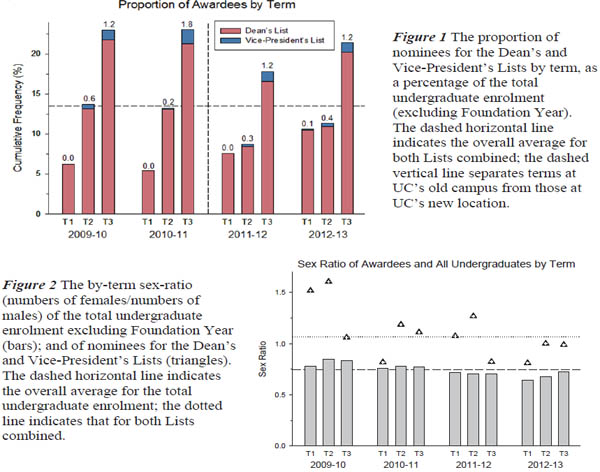
Figure 2 indicates that, whilst there are more male than female students in the undergraduate population as whole (this also applies for Foundation Year), females were proportionately better represented in the list of awardees. This was particularly the case in the first two terms of Academic Year 2009-10, but has persisted to a greater or lesser extent thereafter.
- There is possible hint that the move to the new campus may have had an effect on the sex ratio (with an apparent recent rebound, which is difficult to explain), although further study is required of intake and subsequent relative drop-out rates to determine whether the changes reflect long-term trends or are just random noise.
- The greater proportion of male students is consistent with prevailing patterns of enrolment in higher education in Cambodia, despite UC’s efforts to redress the balance through its scholarship programmes (Munro, 2013b).
- In this respect, Cambodia resembles the Lao PDR and Indonesia; and thus it contrasts with several other ASEAN countries (no data were available for Singapore or Vietnam), as well as many other countries, where there is at least gender parity in terms of the proportion of female tertiary students (UNESCO, 2012).Thus, according to the review of DiPrete and Buchmann (2013), the female:male ratio of College students in the US has changed from about 0.8 in 1970 (cf. Fig. 2) to about 1.2 in 2010, associated with increased proportions of female graduates (including with Ph.D. and especially Master’s degrees – again in contrast to current data for UC) and a partial decrease in the gender-gap in wages.
- The issue of female students tending to perform better will be returned to below.Another dimension of analysis is the fact that undergraduate students enrol for one of four sessions: morning, afternoon, evening or weekend. Figure 3 indicates that the proportion of awardees (weighted for differences in enrolment between sessions) was generally higher for students in the morning and the afternoon sessions, although there is considerable between-term variability.
- In general, the difference in relative performance between genders noted above applied across all sessions for awardees (data not shown).
- Other data (Munro, unpublished) indicate that there has been a general trend for students in the evening and weekend sessions to perform less well than those in the morning and afternoon sessions.
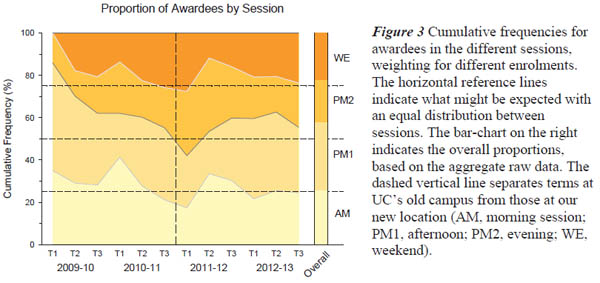
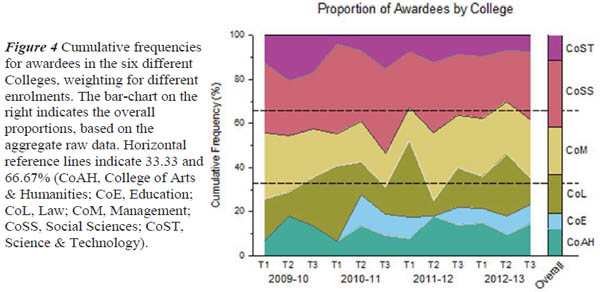
Figure 4 compares the distribution of awardees amongst Colleges after weightage for differences in enrolment between these.
- The overall rankings might be attributed to differences in quality of students and/or aspects of their major courses (e.g. content-difficulty, strictness of marking): the fact that students have to take subjects outside their major might argue against the latter, but again more detailed analyses are required.
- There are no consistent between-term changes for particular Colleges (for example, consistent higher proportions in Term III, given between-College differences in enrolment at other universities: Munro, 2014a and in preparation).
- However there are wide between-term variations in the relative performance of different Colleges – most especially Law and Management – which have no immediately obvious explanation.
General Discussion and Conclusions To summarise the results for AY 2012-3 in relation to the previous three years in which students have been recognised as list nominees:
- There is a continuing trend for a greater proportion of awardees in Term III (Fig. 1), whatever the underlying reason(s) – understanding the latter is critical for fine-tuning UC’s future educational strategy.
- There would seem to be a trend for declines in both the proportion of females in the student population as a whole and the proportion of female awardees, although this will require further study to confi rm.
- There are long-term variations in between-session and between-College performance, the nature (random or otherwise) of which bears further investigation.
The consistent skewing of gender-ratios deserves further consideration, with that amongst awardees being opposite to that for the general student population (Fig. 2).
On the one hand, there is a male-bias in terms of the total student enrolment (more starkly obvious at postgraduate levels): as reviewed by Munro (2014), this is likely to refl ect (i) traditional values regarding the broader roles of the two genders in Cambodian society, including in the context of (ii) the need to prioritise a family’s often limited resources in favour of male offspring (see also ILO [2013], pp. 27-28) given problems of access to sources of funding (Munro, 2014).
To consider first the latter point: at the institutional level, one obvious way to obviate the problem of giving priority to male offspring is to promote the enrolment of female students through scholarships, which UC seeks to do.
However, whilst this might help to promote a more fundamental societal change in gender-perception, it goes only a small way towards addressing the need for updating traditional values to promote greater genderequality (one of the Millennium Development Goals).
To this end, UC has a compulsory General Education course (WMN201) to promote gender-awareness in the upcoming generation of future leaders.
Furthermore, it could be argued that traditional values are limiting the male half of Cambodia’s youth from reaching their full potential. A starting point is to consider the conclusions of a recent detailed survey of gender in higher education in the US (unfortunately not consulted in full). DiPrete and Buchmann (2013) attributed the recent dramatic change in gender-ratio to differences in attitude at earlier levels.
- This is presaged by a pre-College achievement gap, with girls outperforming boys despite no overall difference in cognitive abilities.
- This was related to differences in engagement (motivation and enjoying school) and effort vs. socializing and other activities: young males are essentially more complacent about educational pursuits.
- They attributed these explanatory differences to societal norms in the US rather than intrinsic sex-based differences.
- They argue that schools need to set high expectations without gender-stereotyping and seek ways to motivate male students, in particular, to take a longer-term view of the importance of education.
A recent study in the UK argued that female students may have a greater psychological resilience in the need to adapt to the new challenges they confront in entering the higher education system.
- Thus it was proposed that there is the need for more counselling, especially of males, to ease the transition to the new learning environment.
- One way of interpreting the foregoing is in terms of preconceived male entitlement and females’ perceived need to advance themselves.
- Thus female students, whether in the US, the UK or wherever, are motivated to work harder in order to advance themselves as individuals in today’s more equitable world.
Male students are more complacent because of their upbringing and their perceived ‘birthright’ in all spheres – for example, in Alaska – which reflects a sort of motivational inertia in the face of a changing global environment.
To now focus in on the Cambodian situation:
- Female students have difficulty finding suitable accommodation outside the family (in contrast to males, who can stay in pagodas): thus UC has long-term plans for the construction of hostels, as part of the remit of the UC Foundation.
- It is possible to explain the increased proportion of female awardees at UC (Fig. 2) in the light of what was reviewed above regarding studies in the US and UK, but further analyses are required to determine whether better female performance applies to the student population as a whole, and whether there are any potential modifying factors.
3 Executive Summary: //www.russellsage.org/sites/all/fi les/riseofwomen_brief_04082013_web.pdf
4 See also //www.nytimes.com/2006/07/09/education/09college.html?pagewanted=all
5 //www.leedsmet.ac.uk/news/1471.htm
6 //www.insidehighered.com/quicktakes/2010/02/01/another-take-gender-gap
7 http://www.phnompenhpost.com/7days/women-still-falling-higher-education-ladder
- Male-specific complacency, argued to apply elsewhere, can be seen in a broader cultural context (including engrained sexual attitudes).
- Cross-gender complacency can be expected because of the problem of the perceived lack of meritocratic transparency in various job-appointments (something refl ected in students’ responses to the Comprehensive Exam taken to complete their Bachelor’s degrees: Munro 2014): some students may not bother to work hard, because there is no need to prove themselves in competition with others (who may become cynical as a result).
- Superimposed on this, ‘inter-institutional complacency’ might be expected, given the range of quality in local universities, with some having a better reputation with employers than others: thus simply being accepted to a degree programme in one of the ‘better’ universities gives a student an inherent advantage, with a scholarship as the icing on the cake to further lull them into a feeling of complacency.
So, how else can UC further improve its educational programmes for the benefit of all (apart from long-term plans to build student hostels: see above)? UC sets high performance standards, and its students are attractive to employers. This could give rise to two potentially conflicting issues: a good institutional reputation vs. ‘inter-institutional complacency.’
1. To consider the level of standards first:
- We set high standards regarding scoring students’ performance (although presumably our faculty adjusts their marking accordingly), aiming to motivate students to earn high grades, and thus be nominated for the lists which are the subject of this article.
- Whilst we do have induction courses in the Foundation Year to help new students make the transition to a new learning environment, there would seem to be the need for further counseling to make new students (including in CES for International Track students) more psychologically resilient, with increased capacity to adapt.
- Based on the foregoing UK study, this might be expected to help male students to adapt to the new study situation and UC’s high grade expectations, all else being equal.
- This is one of the aims of the Student Development Centre, currently in the planning stage.
- The bottom line is that we must promote personal responsibility and seek to help students to realise the fruits of this.
2. Regarding our students’ employability:
- Our reputation is such that our students have an intrinsic advantage in applying for jobs in at least certain areas … which might encourage complacency.
- This attitude is potentially reinforced by the fact that many students are on scholarships – they have no concrete personal investment to lose (in contrast to when their source of financing is through their parents directly or via loans).
- Thus, if the going gets tough, then scholarship students start giving up, with nothing to lose: an argument for offering student-loans rather than scholarships? (but see Munro, 2014a).
3. The situation is further complicated by the fact that about 80% of UC students are studying at another university and or having a job (Munro, 2014a): thus there is no focus of commitment for the majority of them.
- The problem could be ameliorated if universities in Cambodia were allowed to offer joint degrees, so that students do not need to transit between two universities to study two separate majors and thus are able to focus more on their studies (Munro, 2014).
References:
DiPrete, T. A., and C. Buchmann (2013) The Rise of Women - The Growing Gender Gap in Education and What It Means for
American Schools Note that only the Executive Summary (//www.russellsage.org/sites/all/fi les/riseofwomen_brief_04082013_
web.pdf) and //www.russellsage.org/sites/all/fi les/diprete_fi gurestables.pdf were accessible.
ILO (2013) Cambodia Labour Force and Child Labour Survey 2012: Labour Force Report. Phnom Penh: ILO.
Munro, A. D. (2009) The Examination System and Quality Assurance at the University of Cambodia. UC Bulletin 3(3), 6-7.
Munro, A. D. (2011) The need for professional benchmarking of standards in Cambodian Universities, in light of UC’s Australian
Experience. UC Bulletin 13, 13-15.
Munro, A. D. (2013a) Overview of Student Awards for Academic Year 2012-2013. UC Bulletin 14, 6 and 34.
Munro, A. D. (2013b) The University of Cambodia and Human Capital Development. UC Bulletin 14, 11 and 28-32.
Munro, A. D. (2013c) Comprehensive exam UC Bulletin Vo. 15, pp. 32-33.
Munro, A. D. (2014) The Busy UC Undergraduate: An Interim Report. UC Bulletin (this issue).
UNESCO (2012) Wo